When business owners think about improving their website, the conversation usually starts the same way.
“Should we add a chatbot?”
“What about an online scheduler?”
“Maybe we need more animations.”
“Should we redesign the homepage?”
New features can be exciting, but here’s a different way to think about it:
Your website probably doesn’t need more features. It needs fewer frustrations.
The websites that generate the most leads aren’t always the ones packed with the latest technology. They’re the ones that make it incredibly easy for customers to find what they need and take the next step.
Every Frustration Costs You a Customer
Imagine walking into a store where the signs are confusing, the checkout line is slow, and no one is available to answer your questions.
You’d probably leave.
Your website works the same way.
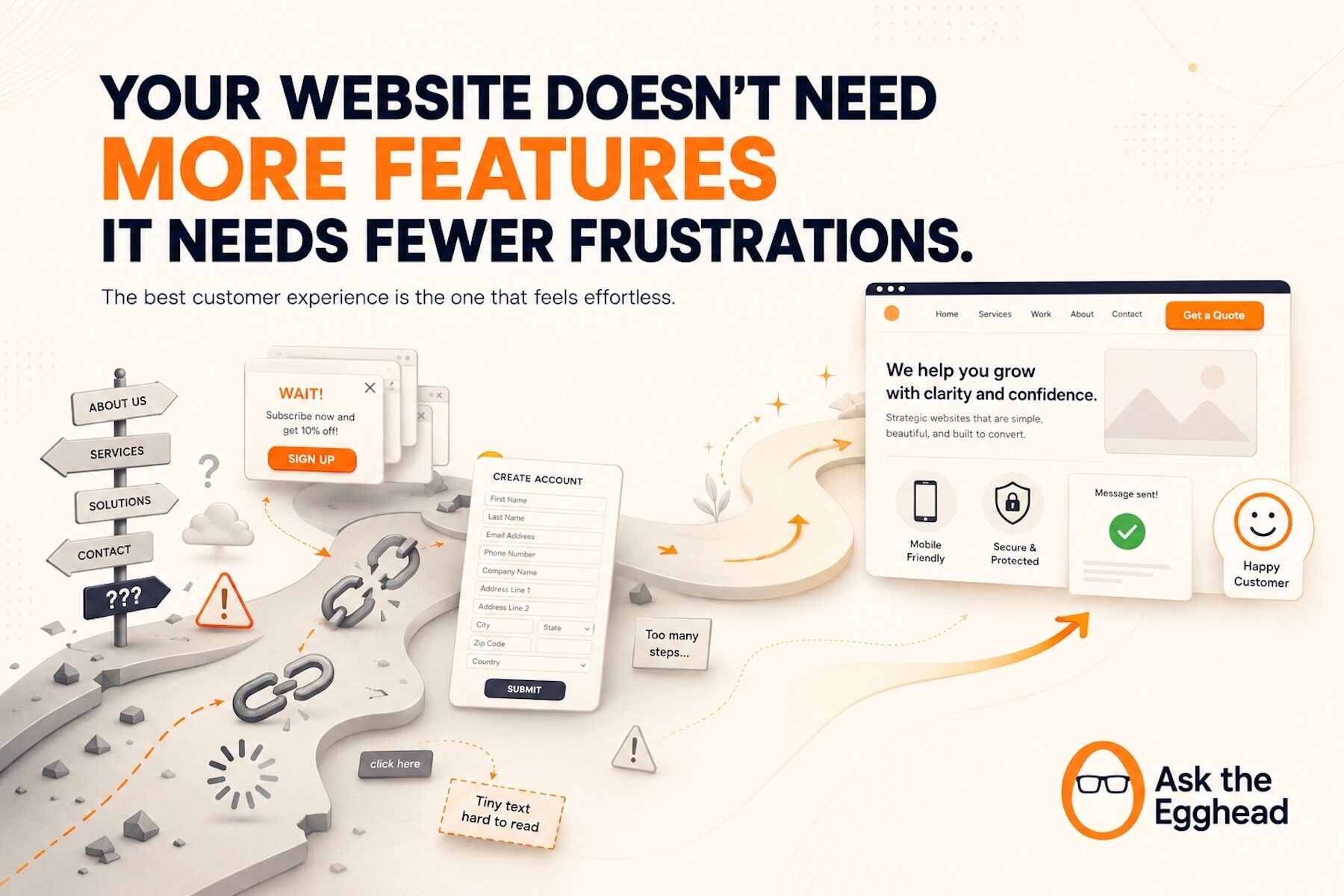
Every confusing menu, broken link, slow-loading page, or difficult contact form creates friction. While each issue may seem small on its own, together they can convince visitors to leave before they ever become customers.
The challenge is that most people won’t tell you they were frustrated.
They’ll simply move on to another business.
Simplicity Wins
Customers visit your website because they have a goal.
They want to schedule an appointment.
Request a quote.
Buy a product.
Find your phone number.
Learn about your services.
The faster they can accomplish that goal, the better their experience will be.
The best websites don’t overwhelm visitors with endless choices. They guide them naturally from one step to the next.
Simple navigation, clear messaging, and obvious calls to action almost always outperform websites that try to do too much.
More Features Can Mean More Problems
Every plugin, widget, animation, or third-party integration adds another layer of complexity.
Sometimes those additions provide real value.
Other times they slow your website down, create compatibility issues, or distract visitors from the action you actually want them to take.
Before adding something new, ask yourself one question:
Does this make it easier for my customer—or just more interesting for me?
If it doesn’t improve the customer experience, it may not belong on your website.
The Best User Experience Often Goes Unnoticed
Think about the last website you enjoyed using.
You probably don’t remember the colors or animations.
You remember how easy it was.
You found the information quickly.
The pages loaded fast.
The forms worked.
Everything simply made sense.
That’s what creates trust.
Customers don’t remember websites that show off. They remember websites that respect their time.
Remove Obstacles Before Adding Features
Before investing in another redesign or the latest website trend, look for opportunities to remove friction.
Ask yourself:
- Can visitors find our contact information in seconds?
- Is our navigation simple and clear?
- Do our pages load quickly?
- Are our contact forms short and easy to complete?
- Does the website work just as well on a phone as it does on a desktop?
- Are our calls to action obvious?
Often, improving these basics has a greater impact than adding another feature.
Your Website Should Make Business Easy
Your website isn’t there to impress people with technology.
It’s there to help people become customers.
Every unnecessary click, every confusing page, and every delay gives visitors another reason to leave.
Every obstacle you remove gives them another reason to stay.
The businesses that consistently grow online understand this simple truth: success isn’t about having the most advanced website. It’s about having the easiest one to use.
Because when customers don’t have to think about how to use your website, they can focus on why they should choose your business.
Wondering if your website is making it easy—or frustrating—for customers to do business with you? Contact Ask the Egghead today for a professional website review. We’ll help you identify the friction that’s costing you customers and recommend practical improvements that make a real difference.