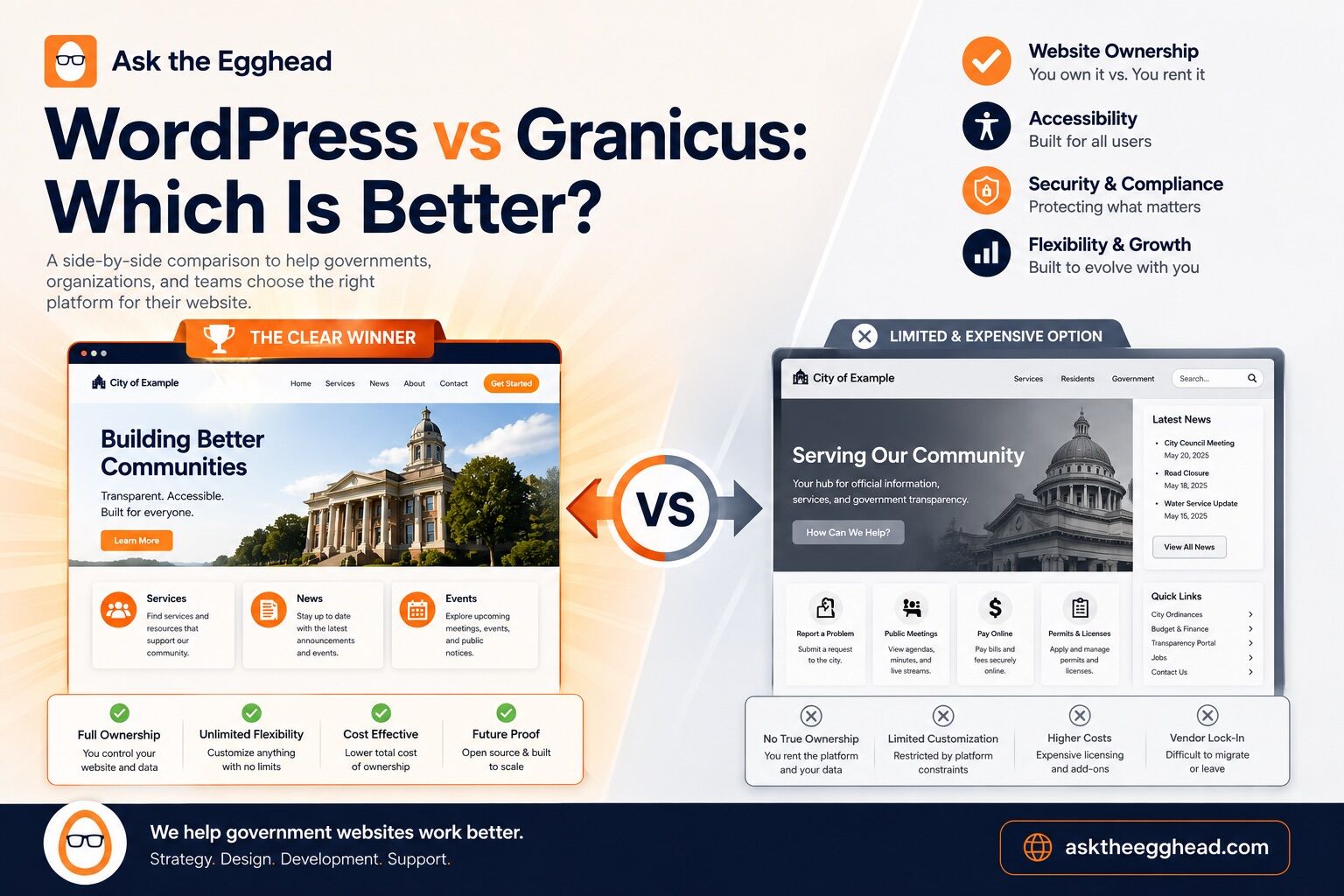
When local governments begin evaluating website platforms, the conversation often comes down to one important question: Should we choose WordPress or Granicus govAccess? Both are respected options, but they serve organizations in very different ways. The right choice depends on more than just features—it depends on who controls your website, how much flexibility you want in the future, and what happens if your needs change.
At Ask the Egghead, we believe the best technology decisions are informed ones. Rather than focusing solely on today’s requirements, it’s important to consider where your organization will be five or even ten years from now.
Understanding Granicus govAccess
Granicus govAccess is a proprietary content management system designed specifically for government organizations. It provides hosting, templates, workflow tools, and integration with other Granicus products such as meeting management, public communications, and citizen engagement.
For municipalities planning to invest heavily in the Granicus ecosystem, this integrated approach can be a significant advantage. Staff members can manage content without extensive technical knowledge, and the platform is supported entirely by Granicus.
However, that convenience comes with an important tradeoff: the platform itself is owned and controlled by the vendor.
The WordPress Difference
WordPress is an open-source content management system used by organizations around the world, including many government agencies.
Unlike proprietary platforms, a professionally developed WordPress website belongs to the organization—not the developer or hosting provider. If you decide to move to another hosting company or work with a different agency, your website moves with you.
This ownership provides long-term flexibility that many municipalities don’t fully appreciate until years into a contract.
Instead of renting a platform, you’re investing in a digital asset your organization controls.
Ownership Matters More Than You Think
One of the biggest differences between WordPress and Granicus isn’t visible on launch day—it’s visible when your contract ends.
With a proprietary CMS like govAccess, your content can typically be exported, but the website itself, including templates, custom functionality, and overall design, remains tied to the vendor. Transitioning away often requires rebuilding the website from the ground up.
With WordPress, your complete website remains yours. Changing vendors or hosting providers doesn’t mean starting over.
For many public agencies, that portability can significantly reduce future costs and procurement headaches.
Accessibility Is an Ongoing Commitment
Government websites must continually evolve to meet accessibility requirements.
Recent ADA Title II regulations make WCAG 2.1 Level AA compliance a continuing responsibility rather than a one-time project. Regardless of platform, accessibility requires regular monitoring and improvements.
The key difference is control.
On an open WordPress website, accessibility improvements can be implemented whenever they’re needed by your chosen development partner.
With proprietary systems, organizations often rely on vendor development schedules for platform-level changes.
Neither solution automatically guarantees compliance, but ownership can provide greater flexibility when deadlines matter.
Looking Beyond the Initial Price
The lowest proposal isn’t always the least expensive solution.
When evaluating website platforms, consider the total cost of ownership over the life of the website, including:
- Licensing fees
- Hosting costs
- Maintenance and support
- Future enhancements
- Migration or exit costs
While proprietary platforms may offer attractive bundled pricing initially, rebuilding an entire website at the end of a contract can become a substantial expense.
With WordPress, ongoing maintenance remains important, but organizations avoid many of the costs associated with vendor lock-in.
Which Platform Is Right for Your Government?
Granicus govAccess is a capable platform that makes sense for governments committed to the broader Granicus ecosystem and those seeking a single vendor relationship.
WordPress is often the better choice for organizations that value:
- Website ownership
- Long-term flexibility
- Vendor independence
- Greater control over accessibility improvements
- Lower migration costs in the future
Neither platform is objectively “better” for every organization. The right decision depends on your priorities, procurement strategy, and long-term digital goals.
Before signing any CMS contract, ask one simple question:
“If we leave in five years, what exactly do we own?”
The answer may tell you more than any feature comparison ever could.
Ready to explore a government website that your organization truly owns? Contact Ask the Egghead today for a no-pressure consultation. We’ll help you evaluate your options, explain the tradeoffs, and build a website strategy that serves your community today—and well into the future.