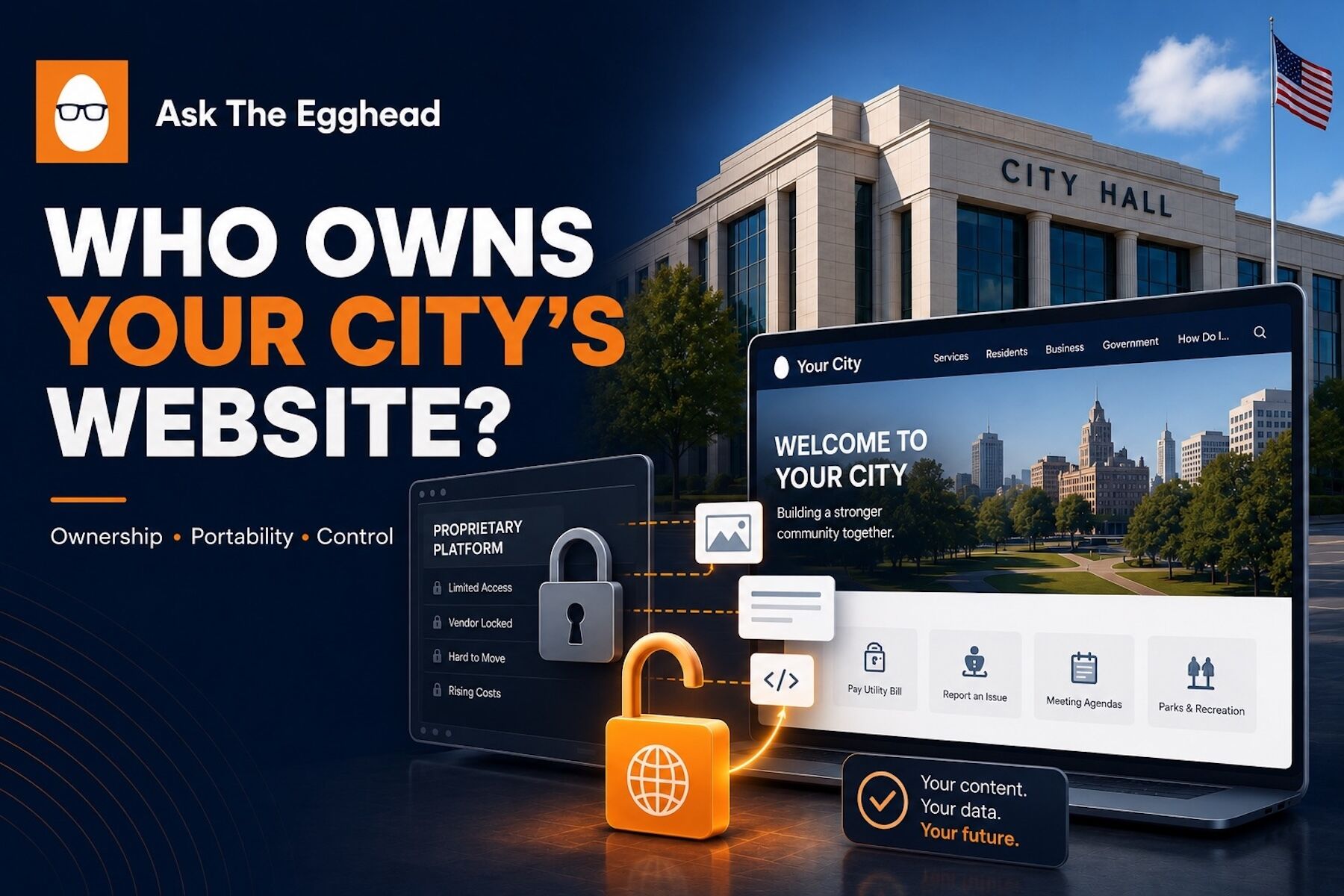
Most local governments assume they own their website. After all, they paid for the design, supplied the content, and continue paying for hosting and maintenance. But there is a more important question every municipality should ask: If we changed vendors tomorrow, could we take our entire working website with us?
For many cities and towns, the answer is no.
Understanding who owns a government website is about more than contract language. True ownership affects your municipality’s budget, flexibility, accessibility efforts, and ability to choose technology partners in the future.
Government Website Ownership Means Portability
A contract may clearly state that your municipality owns its content. That sounds reassuring, but website content ownership and website ownership are not the same thing.
Your city may own its text, photographs, documents, and other uploaded materials while the vendor owns or controls the content management system, templates, design framework, integrations, and custom functionality that make everything work.
A better ownership test is simple: Can your city leave its current provider with a complete, functioning website?
If the answer is no, your municipality may effectively be renting its website rather than owning it.
A Content Export Isn’t Your Website
Many proprietary government website platforms offer content exports. While useful, an export does not necessarily provide true city website portability.
Imagine moving out of a furnished apartment. You can pack your clothes, books, and personal belongings, but you cannot take the walls, cabinets, or floor plan.
A website export works similarly. Your municipality may receive its text, images, documents, and database records without receiving the underlying platform, templates, navigation structure, integrations, or years of configuration.
Moving to another provider can then require rebuilding the website, reformatting content, creating redirects for existing URLs, configuring features, and retraining employees.
Suddenly, changing vendors becomes a major project rather than a straightforward hosting decision.
What Does Real Website Ownership Look Like?
True ownership gives your municipality control over the working website itself.
Open-source platforms such as WordPress can provide this flexibility because the software is openly licensed and can be hosted and maintained by different qualified providers. A municipality can change hosting companies, hire another developer, or potentially manage the website internally without automatically rebuilding everything from scratch.
Think of the difference this way: with an owned, portable website, changing providers means changing who holds the keys. With a proprietary rented platform, changing providers may mean building a new house.
That distinction can have significant financial consequences.
Why Ownership Matters for Local Government
Website ownership is particularly important in the public sector. Municipal budgets face scrutiny, procurement processes can take months, and unexpected website rebuilds can create costs that must be explained to elected officials and residents.
Local governments also need to maintain continuity of online services and access to public information during technology transitions.
Accessibility adds another important consideration. The Department of Justice’s accessibility requirements for state and local government websites make ongoing accessibility work increasingly important. When municipalities control their websites, they have greater freedom to address problems directly or choose qualified partners to perform the work. On a proprietary platform, some template or code changes may depend entirely on the vendor.
Ask Your Website Vendor These Questions
Not sure whether your city owns its website? Start by asking your current or prospective provider:
- If we leave, do we receive a complete working website or only our content?
- Can another hosting company host the existing website?
- Who owns the templates and custom code we paid to develop?
- Can another developer maintain and modify the website?
- What costs and technical work would be required to migrate elsewhere?
If the answers repeatedly point to the vendor’s infrastructure, proprietary software, or exclusive control, your municipality should understand the long-term implications before signing or renewing a contract.
Website ownership ultimately comes down to control and choice. Your city should understand exactly what it is purchasing—and what happens if it eventually decides to leave.
Ready to gain greater control over your municipality’s online presence? https://www.asktheegghead.com/contact/ to discuss a portable, professionally managed WordPress website built around your community’s long-term needs.