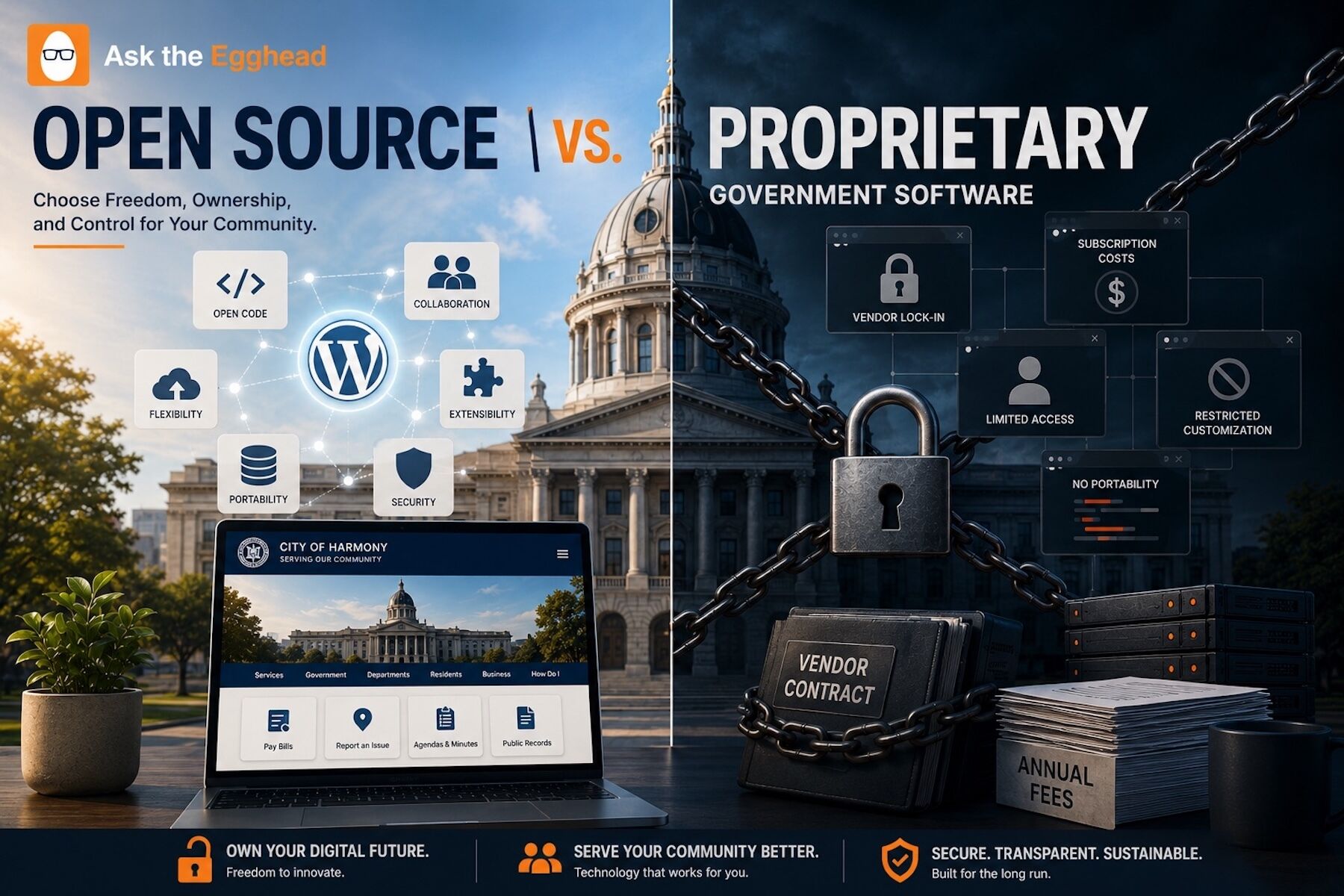
When local governments evaluate new website platforms, two terms appear again and again: open source and proprietary software. Vendors may use these labels as selling points, but understanding what they mean is essential before making a long-term technology decision.
Choosing between proprietary software and an open source government website isn’t simply about technology. It’s about cost, control, ownership, portability, and how much freedom your government retains after signing a contract.
What Is the Difference Between Open Source and Proprietary Software?
Proprietary software is owned and controlled by a specific company. Your organization purchases a license or subscription giving you permission to use the platform, but the vendor retains control of the underlying software.
That can create limitations. Your government may not be able to host the software elsewhere, modify its code independently, or hire another provider to maintain the same system.
Open-source software works differently. Its license allows the software to be used, hosted, and modified by others. WordPress is one of the best-known examples.
For local governments, that distinction can be significant. An open-source website can be hosted with different providers and maintained by qualified developers without requiring the municipality to remain with the company that originally built it.
Comparing Cost and Long-Term Control
Cost is often one of the first considerations when evaluating open source vs. proprietary software for government.
Proprietary platforms commonly include recurring licensing or subscription fees. Open-source software generally eliminates licensing fees for the core platform, but that doesn’t make the website free. Governments still need professional hosting, security, maintenance, updates, and technical support.
The difference is what you’re paying for.
With open source, governments can competitively shop for those services instead of paying a recurring software license controlled by one vendor.
Control matters just as much. With proprietary software, updates, customizations, and fixes generally depend on the vendor’s capabilities, schedule, and pricing. Open source allows a government to work with any qualified provider capable of supporting the platform.
That flexibility can become especially important when addressing urgent security, accessibility, or compliance requirements.
Open Source Can Reduce Vendor Lock-In
Proprietary software lock-in is another issue governments should consider before selecting a platform.
When a website operates entirely inside a vendor’s proprietary environment, changing providers may require rebuilding some or all of the website. Open-source platforms are designed to be portable, making it possible to move the website to another hosting environment or service provider.
In practical terms, the difference can be between moving an existing digital asset and rebuilding it.
For municipalities investing public funds into websites intended to serve residents for years, that distinction deserves careful consideration.
The “Public Money, Public Code” Principle
The concept of public money, public code argues that software funded with public resources should be open and reusable whenever practical.
Open-source technology can support that principle because improvements aren’t necessarily confined to one vendor’s private product. Work created for one government may potentially benefit others using the same open platform.
Large public organizations also use open-source technology. As noted in the source material, California has consolidated numerous state websites onto a WordPress-based platform, while NASA operates a significant WordPress deployment.
Open source isn’t limited to small organizations or experimental projects.
When Proprietary Software Makes Sense
Open source isn’t automatically the correct answer for every government.
A proprietary solution may make sense when an organization wants one vendor responsible for an entire suite of services or when specialized software offers functionality without a suitable open-source alternative.
Some municipalities may also value the convenience of placing most technology responsibilities with one provider more than portability.
The important thing is understanding that tradeoff before making the decision.
Open Source Still Requires Professional Management
Open-source software also isn’t automatically secure, reliable, or well maintained simply because its code is available.
Poor hosting, neglected updates, weak security practices, or inadequate maintenance can create serious problems. A successful open source local government website still requires experienced professionals to maintain the technology responsibly.
The key advantage is that the government retains greater flexibility over who those professionals are.
Ultimately, choosing between open-source and proprietary government software is a decision about more than features. It’s a decision about who controls an important public asset.
If your city, town, or public agency is evaluating its next website platform, contact Ask the Egghead to explore how a professionally managed WordPress solution can give your organization greater control, portability, and confidence in its digital future.